JERPON HR GUIDE
Juicing oranges for juice and iced orange businesses
Juicing oranges for business are chosen for the juice in the fruit, a taste that suits drinks, and the cost per basket, not for peel color. In Indonesia, Jeruk Siam Pontianak is often used for iced orange drinks and juice because it is sweet and refreshing, has orange pulp, comes from a large growing area in Sambas, and is available in several grades. Jerpon HR supplies these oranges by the basket to juice businesses, cafes, restaurants, hotels, and traders in Jabodetabek.
Why Pontianak oranges are widely used for iced orange drinks
- A familiar taste. Siam Pontianak is known as sweet, smooth, and orange-fleshed. That taste suits everyday drinks.
- A real growing area. Sambas Regency open data records Siam and mandarin orange production of about 1.03 million quintals in 2025 (Open Data Sambas). Regional production figures do not guarantee daily stock; batch availability is still confirmed before you order.
- A choice of sizes. Fruit for serving can be large, while a juicing business can choose a more economical size.
- The market already knows it. The term "Pontianak juicing orange" is widely used by traders and retailers, so drink buyers understand it right away.
Other oranges can be juiced too. Valencia, for example, is widely used by the global juice industry. A broader comparison is in the Citrus Encyclopedia.
Peel color is not the main factor
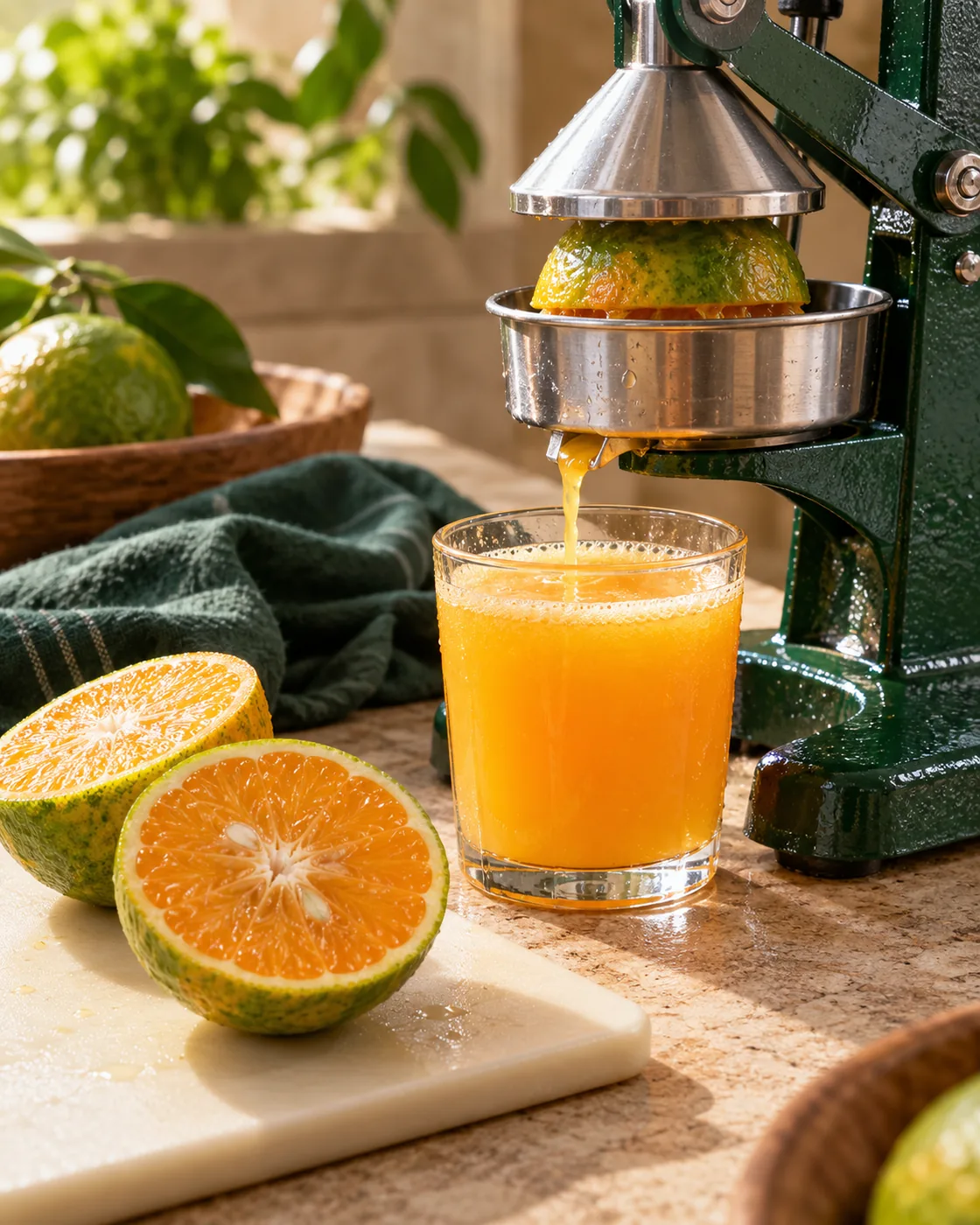
The peel of a Pontianak orange can stay green or yellowish green when the pulp is already orange and ripe. For juicing, what matters more is the juice in the fruit and how consistent it is from basket to basket. Do not reject fruit just because the peel is green, and do not choose fruit just because the peel is yellow.
Which variety suits a drinks business
| Product | Basket | Grades in the catalog | Notes for a drinks business |
|---|---|---|---|
| Jeruk Siam oranges | 15 kg | AA, AB, C, D, E | The widest choice of grades for business, juicing, and resale |
| Jeruk Siam Masak oranges | 10 kg | AB, C, D | A ripe character for daily stock and juicing |
| Madu Super oranges | 10 kg | AA, AB, C, D | The catalog suggests it for gift hampers, restaurants, and hotels |
| Madu Susu oranges | 10 kg | AA, AB, C | The catalog suggests it for eating fresh at home, serving, hotels, and restaurants |
For iced orange stalls and juice businesses with daily volume, Jeruk Siam 15 kg and Siam Masak 10 kg are a sensible starting point because the catalog marks both for juice. The differences between the four varieties are explained in Jeruk Pontianak HR varieties.
Which grade to juice
Grades at Jerpon HR group fruit by size: AA is the largest, then AB, C, D, and E is the smallest. Grade does not indicate sweetness.
- Jeruk Siam 15 kg in grade C, D, or E and Siam Masak 10 kg in grade C or D can be compared with a juicing test. A smaller size does not always give the lowest cost per cup.
- Grades AA and AB make more sense when the fruit is also displayed or served whole, for example in a cafe display or as table fruit in a hotel.
The final choice still depends on the batch, the harvest price, and your business target. Smaller fruit means more fruit to cut and juice per basket; count that labor time too. Photos of each grade are in the grade guide.
How do you work out how many oranges a juice business needs?
Work out how many oranges a juice business needs from a test of one basket, using the same recipe and cup size. Orange cost per cup is the basket price plus the delivery fee per basket, divided by the number of cups from the test. Baskets needed is the target cups per day times the number of days until your next purchase, divided by the cups per basket, rounded up.
- Buy 1 basket in the grade you want to test.
- Record how many cups it makes with your usual recipe and cups.
- Divide the basket price plus the delivery fee per basket by the number of cups. That is the orange cost per cup, not including sugar, ice, water, cups, labor, and other costs.
- Multiply the target cups per day by the number of days until your next purchase, divide by the cups from one basket, and round up. That is the estimated number of baskets to order.
- Repeat with another grade if you want to compare.
For the delivery fee per basket, divide the total delivery fee by the number of baskets in the same delivery. This stock planning is not shelf-life advice; match your purchases to the condition of the fruit and your storage space.
Calculate from your own test
Enter the juice yield from one basket and the price you were quoted. No single glass count applies to every batch.
Fill in all five fields, then calculate. The result will appear here.
This cost covers only the oranges and their share of shipping. Sugar, ice, water, cups, labour, and other costs are not included. The juice yield of the next batch may differ.
A calculation is not an order. Hera confirms stock, price, and delivery before you buy.Looking after the fruit once it arrives
- Store in a cool, dry place. Avoid direct heat, for example near the stove or in the sun.
- Do not stack baskets too high. Too much pressure damages the fruit at the bottom.
- Set aside damaged fruit right away so it does not affect the rest.
- Use the fruit that arrived first, first.
Before delivery, the fruit has already been checked again and stabilized in the HR cold store in West Jakarta.
Regular supply and delivery
Reseller and business orders start from 5 baskets; a first order to test the taste can start from 1 basket. Delivery uses an instant motorbike courier for 1-3 baskets, a car or van for 4-10 baskets, and a large truck for wholesale volume. You can also pick up at the warehouse at Jl. Pekapuran III No. 12, Tambora, West Jakarta, 24 hours a day, every day.
Recurring needs can be discussed based on capacity, sales, and harvest conditions. Stock is still confirmed each time it is needed. Details for businesses are in Pontianak orange supplier for Jabodetabek, and how prices are set is in Pontianak orange prices.
How to order for a business
Send Hera on WhatsApp at 0813-6637-8484: your type of business, the estimated number of baskets per week, the grade you want to try, and the destination area and receiving hours.
Hera confirms stock, available grades, the latest batch price, schedule, and delivery fee before the order goes ahead. You can also put your choice together first in Jerpon Market.
QUICK ANSWERS
What buyers ask most.
Which juicing oranges suit an iced orange drink business?
For an iced orange drink business, Jeruk Siam Pontianak is one of the options for juicing. At Jerpon HR, you can compare Jeruk Siam 15 kg in grade C, D, or E with Siam Masak 10 kg in grade C or D. Choose by juice yield and batch price, then test one basket before ordering regularly.
Which grade is the most economical to juice?
Compare Jeruk Siam 15 kg in grade C, D, or E with Siam Masak 10 kg in grade C or D through a juicing test. The smallest grade is not always the most economical. Work out the orange cost and the share of delivery fee per cup, then weigh labor time, the batch, and the taste.
How many cups does one basket of oranges make?
It depends on the grade, the batch, the juicer, and the cup size. The most accurate way is to test 1 basket with your usual recipe and cups, then record the number of cups.
Can green-skinned oranges be juiced?
Yes. The peel of a Pontianak orange can stay green when the pulp is already orange and ripe. Peel color is not the main factor for juicing.
What is the minimum order for a juice business?
Reseller and business orders start from 5 baskets. For a first taste test, you can order from 1 basket.
What is the difference between juicing oranges and Pontianak oranges?
"Juicing orange" describes a use: oranges bought for their juice. "Pontianak orange" is the name of a Siam tangerine from West Kalimantan. Both can refer to the same fruit, because Pontianak oranges are often sold as juicing oranges. At Jerpon HR, Jeruk Siam comes in grades C, D, and E, and Siam Masak in grades C and D, to compare through a juicing test.
JERPON HR • SINCE 1998